Regeneration Made Simple™
A clearer way to think about recovery, biology, timing, and what may still be possible before replacement becomes the default.
Professor Paul Lee's philosophy is built around one core idea:
Better decisions begin with better understanding.
Why regeneration became so misunderstood
Regeneration is often talked about in extremes.
At one end, it is dismissed too quickly. At the other, it is oversold far too easily.
Both are a problem.
Because regeneration is not magic. But nor is it meaningless.
Professor Lee's view is that regeneration should not be understood as hype, marketing, or wishful thinking. It should be understood more simply — and more usefully — through the relationship between:
That is where Regeneration Made Simple™ begins.
The core belief
At the heart of this philosophy is a simple principle:
If you respect the environment, biology has a better chance to respond.
That does not mean every tissue can regenerate.
And it does not mean every joint can be saved.
But it does mean that outcomes are often influenced by more than a diagnosis alone. They are shaped by:
- the condition of the tissue
- the mechanical environment
- the biological environment
- the timing of intervention
- and the pathway chosen around it
That is why the right question is not always:
“Can this regenerate?”
Sometimes the better question is:
“What environment are we creating for this tissue now?”
Cartilage is not just another tissue
A major part of Professor Lee's work has centred around a simple observation:
Cartilage is different.
It does not behave like bone. It does not behave like muscle. It does not behave like skin.
And one of the biggest mistakes in musculoskeletal care is trying to force every tissue into the same biological logic.
Cartilage does not need to be treated like a failure because it is different. It needs to be respected for what it is.
That means understanding:
- what it tolerates
- what it does not tolerate
- what kind of environment supports it
- and what kind of pathway may quietly accelerate its decline
That is why regeneration begins with respect for tissue, not just treatment.

A simpler regeneration framework
Professor Lee often explains regeneration through a clearer sequence:
This is not meant as a slogan. It is a way of thinking more clearly about how tissues and systems respond.
Physics
The physical environment matters. Load, pressure, movement, force, energy, and mechanics all influence tissue behaviour.
Chemistry
Biological signalling, inflammation, oxygenation, metabolites, and molecular environment all matter.
Biology
Cells, tissue behaviour, healing potential, and regenerative response depend on the environment they are placed in.
Timing
When something happens can be just as important as what is done.
Function
The real goal is not simply a scan or a procedure — but meaningful function, movement, and lived outcome.
Regeneration is rarely about one intervention. It is about the system surrounding it.
Why timing matters more than people think
One of the most overlooked parts of regeneration is timing. The same tissue may respond very differently depending on:
- when it is treated
- what environment it is placed in
- what has already been lost
- and whether the opportunity has already narrowed
That is why Professor Lee's work often centres around the space before replacement.
Because in many patients, the most important decision is not only what to do. It is:
Whether the timing for preservation, repair, or regeneration is still open.
Why this is not just about treatment
Regeneration Made Simple™ is not just about procedures. It is about a broader way of thinking. That includes:
- how patients are assessed
- how tissues are respected
- how recovery is supported
- how pathways are chosen
- and how decisions are made before a joint is simply moved onto a standard track
In that sense, regeneration is not just a therapy.
It is a philosophy of decision-making.
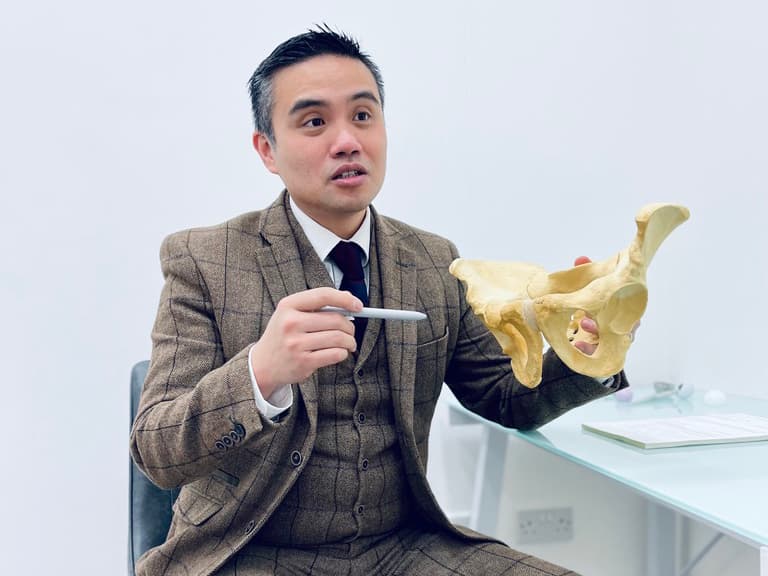
Teaching the next generation of regenerative thinkers
In May 2026, Professor Lee was invited to lecture at the Medical University of Plovdiv, Bulgaria, for the elective course “Molecular, Personalised and Regenerative Medicine”, hosted by Prof. Victoria Sarafian at the Department of Medical Biology.
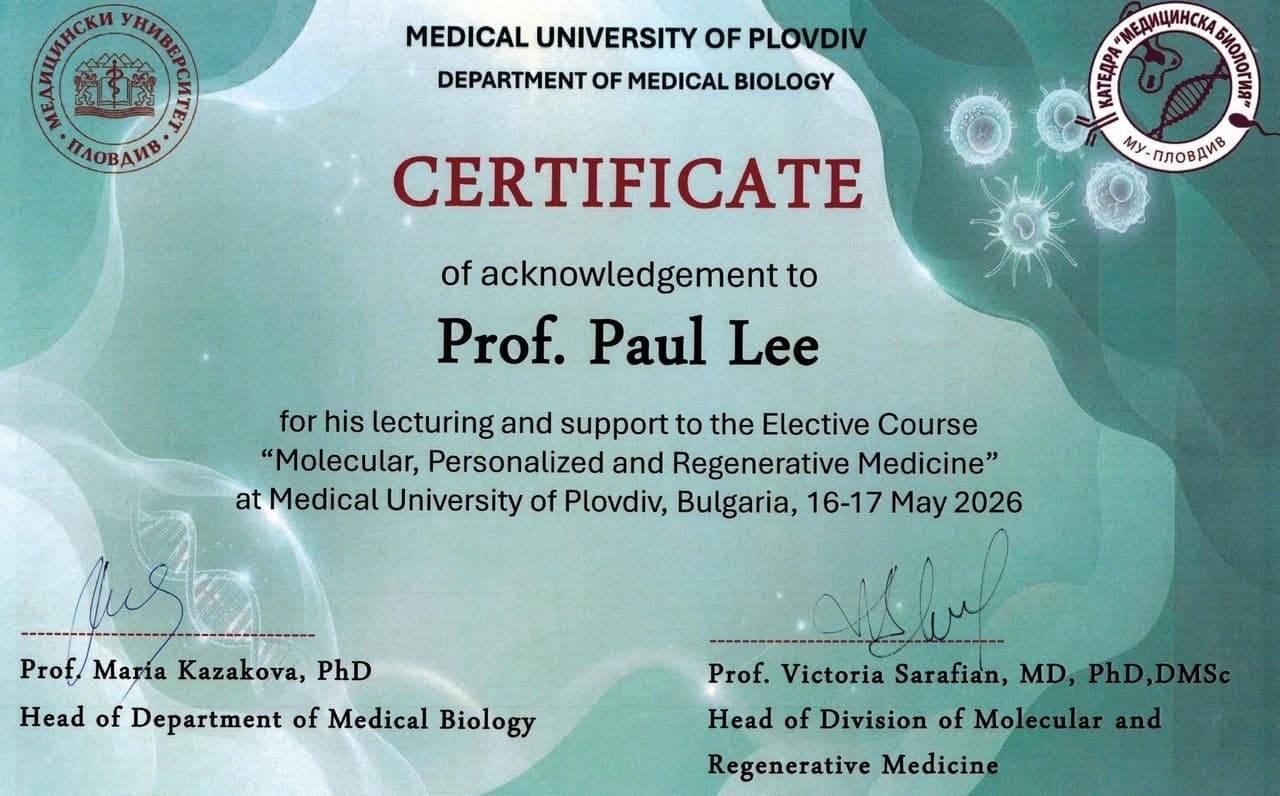
Certificate of Acknowledgement · Medical University of Plovdiv, Department of Medical Biology · 16–17 May 2026
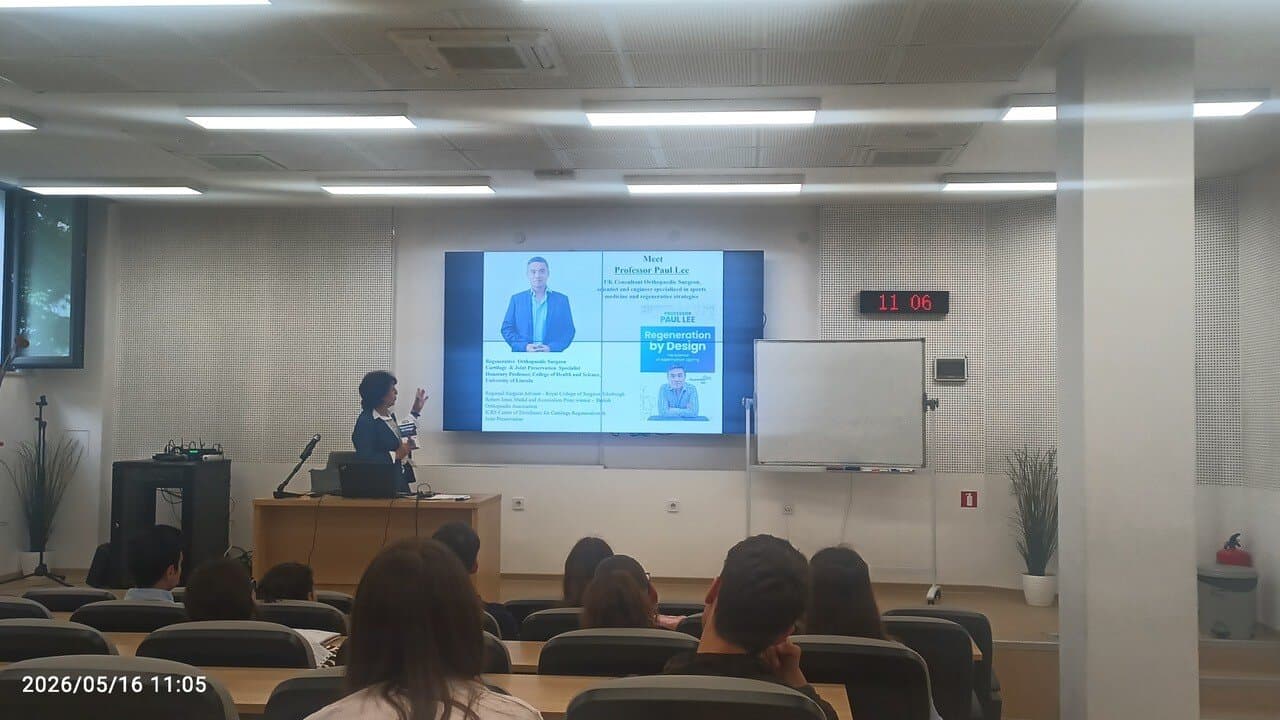
Introducing Professor Lee — Plovdiv, Bulgaria
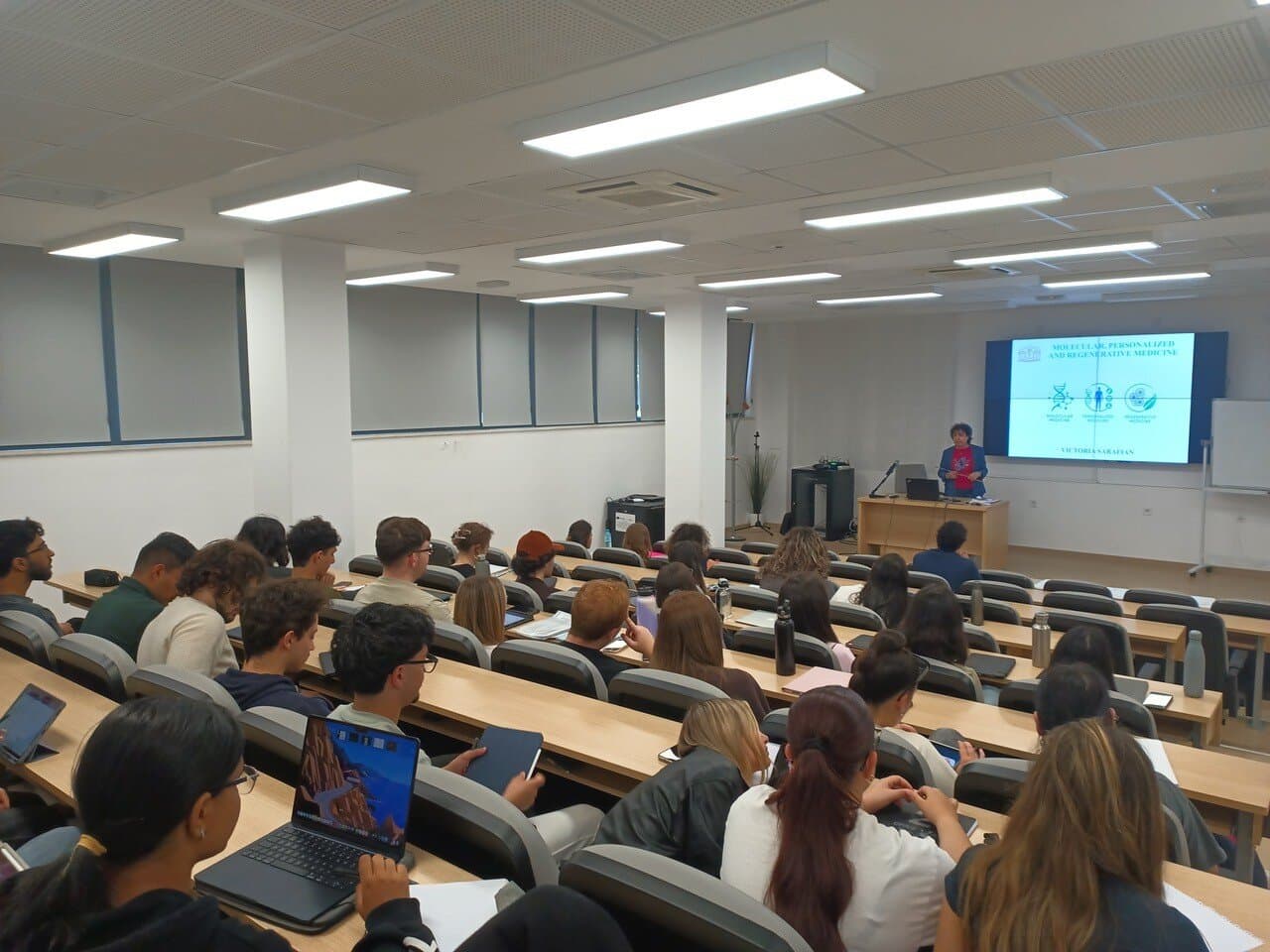
Molecular, Personalised & Regenerative Medicine
Where this philosophy shows up in practice
This way of thinking influences multiple parts of Professor Lee's work.
Cartilage & Joint Preservation
Trying to understand what may still be preserved before replacement becomes the default.
Meniscus, Ligament & Sports Preservation
Looking for better ways to protect function rather than simply removing or replacing what has been lost.
Recovery & Optimisation
Understanding that recovery is not separate from treatment — it is part of the treatment journey.
Regenerative Systems & Innovation
Building better pathways where the current ones do not yet go far enough.
Writing, Education & Public Thought Leadership
Making regenerative thinking clearer, more grounded, and more useful to patients and professionals.
The bigger idea
Professor Lee's work is ultimately driven by a simple belief:
Medicine should not only become more advanced.
It should also become more thoughtful.
That is the spirit behind Regeneration Made Simple™. Not to make regeneration sound glamorous. But to make it make more sense.
Because the future is not just about replacing more
For many patients, the future of musculoskeletal care will not be defined only by what can be removed or replaced. It will also be shaped by how well we learn to:
That is the philosophy behind Regeneration Made Simple™.